The Reporting Burden
Sustainability reporting has become one of the most resource-intensive activities for ESG teams. The average large company now reports against three or more frameworks — GRI for comprehensive sustainability reporting, ISSB for investor-focused climate disclosure, CDP for environmental transparency, and regional requirements like SGX or CSRD. Each framework has its own structure, terminology, and data requirements, creating enormous duplication of effort.
A 2025 survey by the World Business Council for Sustainable Development found that corporate sustainability teams spend an average of 2,400 person-hours annually on report preparation — the equivalent of more than one full-time employee doing nothing but compiling, cross-referencing, and formatting disclosure documents.
AI-Powered Reporting: A Different Approach
XcelGreen's Report Compass agent fundamentally changes how ESG reports are produced. Rather than starting from blank templates and manually populating data points, Report Compass uses the organisation's existing data — already collected, validated, and stored within the platform — to auto-generate report content that meets framework-specific requirements.
Step-by-Step Wizard
Report Compass guides users through the reporting process with an interactive wizard that breaks the task into manageable steps. For each disclosure requirement, it shows what data is available, what gaps need to be filled, and what the AI recommends as the optimal narrative. Users review and refine the AI-generated content rather than writing from scratch.
Multi-Framework Mapping
Because the underlying data is framework-agnostic, Report Compass can generate reports for multiple standards from the same data set. A single set of emissions data, for example, can populate GRI 305 disclosures, ISSB S2 climate metrics, CDP Climate Change responses, and CSRD E1 environmental disclosures — with framework-specific formatting, terminology, and structure applied automatically.
Professional Output Formats
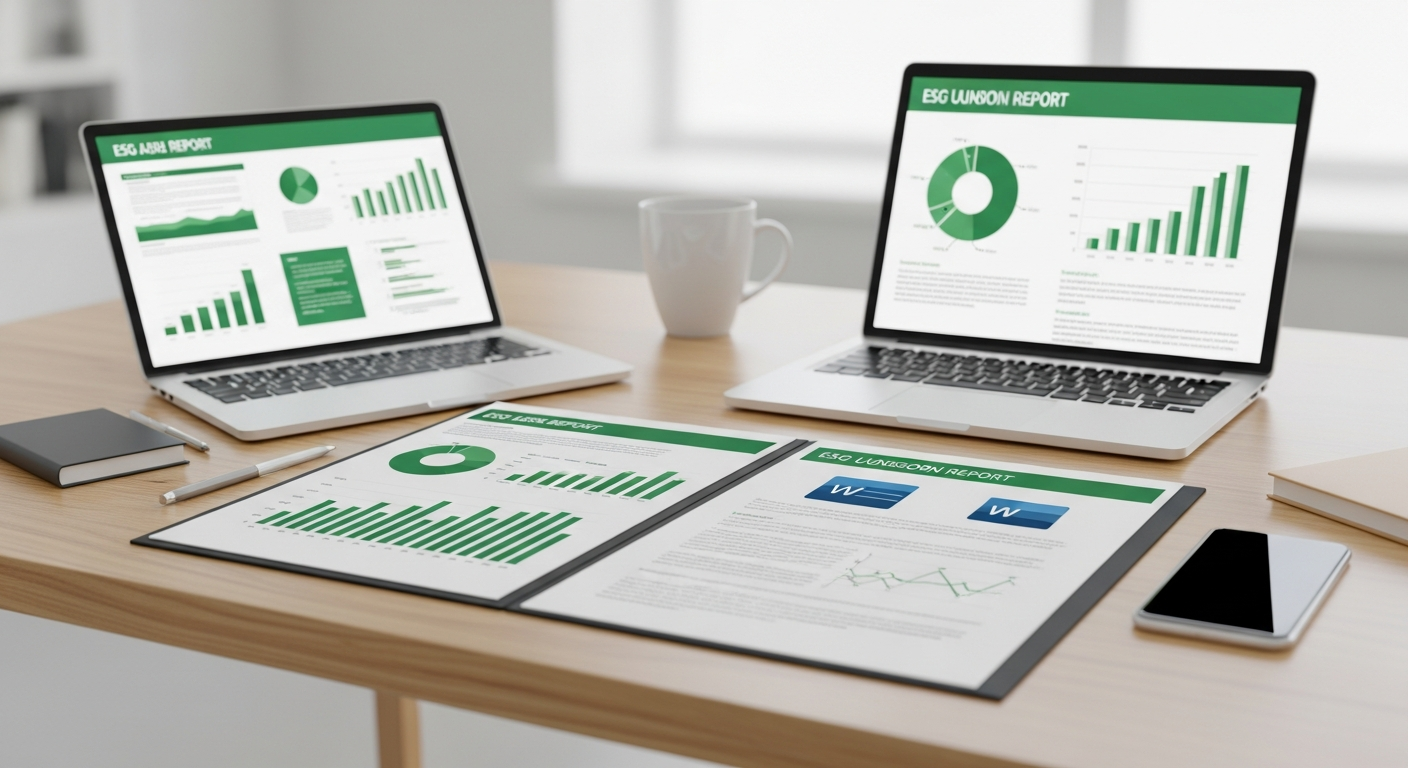
Reports can be exported in multiple formats to suit different stakeholder needs. PDF reports with professional design templates — available in three curated colour themes — are ideal for annual sustainability reports and board presentations. Word documents provide editable drafts for teams that want to refine content further. The system also generates structured data suitable for digital filing and XBRL tagging.
What a Generated Report Includes
A comprehensive GRI report generated through Report Compass typically includes a board message, executive summary with KPI dashboard, SDG alignment mapping, TCFD climate disclosures, a targets roadmap covering 2025 through 2050, three-year performance trends, a complete GRI Content Index with over 60 entries, an assurance statement template, and a methodology appendix. All data points are linked back to their source records, providing full traceability for auditors.
Continuous Reporting Readiness
Perhaps the most transformative aspect of AI-powered reporting is the shift from periodic to continuous reporting readiness. Because data flows into the platform continuously — from Data Workspace integrations, Carbon Compass calculations, and Risk Compass assessments — the report is always substantially complete. When reporting season arrives, the work is review and refinement rather than data collection and compilation.
This continuous readiness also supports interim and real-time reporting needs. Investors increasingly expect quarterly ESG updates, and regulations like the EU Taxonomy require annual reporting that aligns with financial calendars. With Report Compass, producing mid-year updates or interim disclosures is a matter of selecting the reporting period and generating the output — not restarting the entire data collection process.