Assurance Is No Longer Optional
The era of unaudited sustainability reports is ending. CSRD requires limited assurance of sustainability disclosures from day one, with a planned transition to reasonable assurance — the same standard applied to financial statements. SEC climate rules, where applicable, similarly require attestation. And investors are increasingly discounting ESG data that has not been independently verified.
For many organisations, this represents a significant operational challenge. Financial auditing benefits from decades of standardised processes, control frameworks, and professional infrastructure. Sustainability assurance is still maturing, and most companies lack the systematic evidence management capabilities that auditors require.
The Evidence Challenge
Sustainability data comes from diverse sources — utility bills, supplier invoices, operational systems, manual measurements, surveys, and estimates — each with different levels of reliability and verifiability. An auditor examining a GHG inventory needs to trace every reported figure back to its source, verify the calculation methodology, confirm the emission factor applied, and assess the completeness of the data set.
When this evidence is scattered across email inboxes, shared drives, local spreadsheets, and various operational systems, the assurance process becomes painfully slow and expensive. Missing evidence triggers audit queries that disrupt sustainability teams for weeks. Inconsistent documentation raises questions about data integrity that can delay or qualify assurance opinions.
XcelGreen's Assurance and Certification Hub
The Assurance and Certification Hub provides the infrastructure that sustainability teams need to achieve and maintain assurance readiness:
Evidence Locker
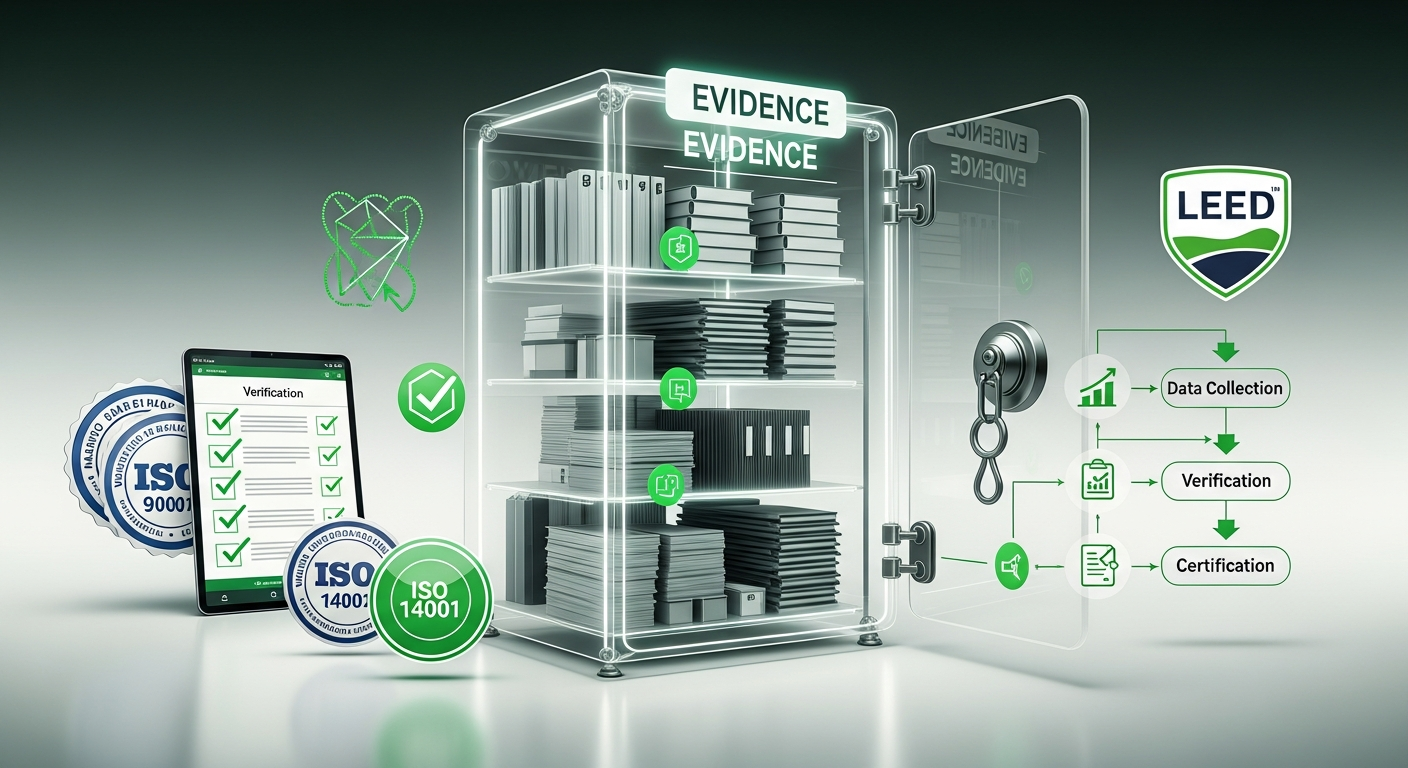
The Evidence Locker is a centralised, secure repository for all supporting documentation related to ESG disclosures. Every data point in the platform can be linked to its source evidence — whether a scanned invoice, a supplier certificate, a meter reading, or a calculation worksheet. Evidence is versioned, timestamped, and access-controlled, creating an immutable audit trail.
When auditors request evidence for a specific disclosure, the sustainability team can provide a complete package instantly rather than spending days hunting through file shares and email archives.
Verification Checklists
Assurance standards require systematic verification procedures. The platform provides customisable checklists aligned with ISAE 3000 (Revised) and ISAE 3410 — the international standards for sustainability assurance engagements. These checklists guide internal teams through pre-assurance reviews, ensuring that common issues are identified and resolved before the auditor arrives.
Audit Trail
Every change to ESG data within the platform is logged with a timestamp, user identification, and description of the change. This complete audit trail demonstrates data governance and helps auditors assess the reliability of the reported information. The system also flags where estimates have been used and documents the estimation methodology and rationale.
Certification Programme Tracking
Beyond financial assurance, many organisations pursue voluntary certifications — ISO 14001 for environmental management, ISO 50001 for energy management, LEED and BREEAM for buildings, or industry-specific programmes. The Certification Hub tracks certification status across the portfolio, manages renewal timelines, and monitors the requirements for maintaining certification.
From Burden to Competitive Advantage
Organisations that invest in assurance readiness early gain multiple advantages. The assurance process itself becomes faster and less expensive as auditors spend less time requesting and reviewing evidence. Stakeholder trust increases when ESG data carries an independent assurance opinion. And the discipline of maintaining audit-ready evidence management improves overall data quality, making every other use of ESG data — from strategy to reporting to investor communications — more reliable.
The trajectory is clear: sustainability assurance will converge with financial assurance in rigour, scope, and expectations. Organisations that build the infrastructure now will be well-positioned as standards tighten. Those that wait will face increasingly costly and disruptive catch-up exercises.