The Hidden Variable in Carbon Accounting
When most people think about carbon footprint accuracy, they focus on activity data — how many litres of fuel were consumed, how many kilowatt-hours of electricity were used. But there is an equally important variable that receives far less attention: the emission factor applied to that activity data.
An emission factor is the coefficient that converts activity data into greenhouse gas emissions. Use a factor for grid electricity in Norway (where hydropower dominates) for operations in Australia (where coal remains significant), and your reported emissions could be off by a factor of ten. Apply a 2015 factor when a 2024 update is available, and you are working with outdated science.
The Scale of the Challenge
The universe of emission factors is vast and fragmented. The IPCC publishes default factors for national greenhouse gas inventories. The IEA provides country-specific electricity grid factors. The EPA maintains factors for US-specific activities. DEFRA publishes annually updated conversion factors for the UK. Industry bodies publish sector-specific factors for maritime, aviation, construction, and other sectors.
Each source uses different methodologies, scopes, and update cycles. Factors are denominated in different units. Some cover CO2 only; others include all Kyoto Protocol gases expressed as CO2 equivalents. Navigating this landscape manually is a recipe for errors and inconsistencies.
A Curated, Unified Database
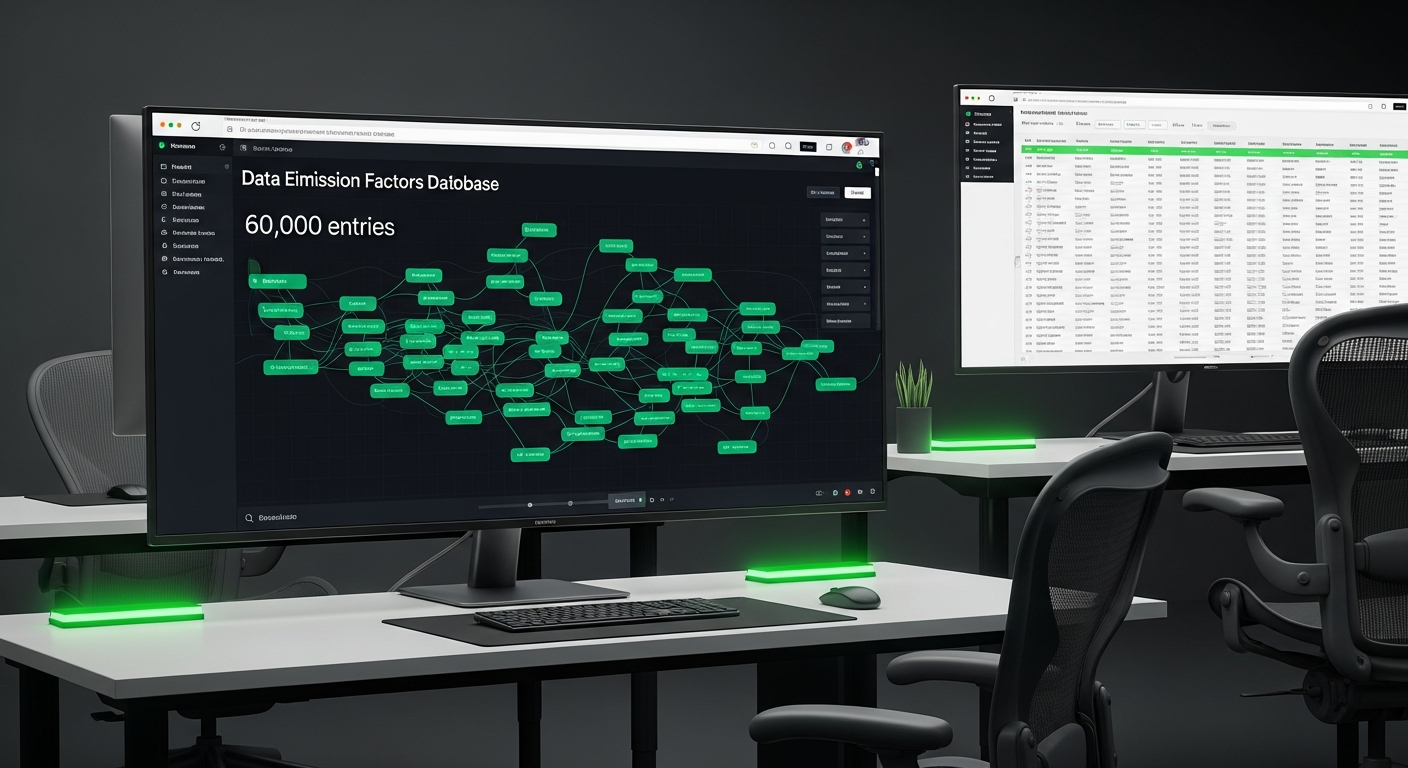
XcelGreen's Emission Factors Database brings together over 60,000 emission factors from authoritative sources worldwide into a single, searchable, regularly updated library. Every factor is tagged with its source, publication date, geographic scope, applicable sector, gas coverage, and calculation methodology — making it possible to find the most appropriate factor for any activity in any location.
The database is structured to support the GHG Protocol's calculation hierarchy: location-based, market-based, and supplier-specific approaches for electricity; activity-based, distance-based, and spend-based methods for Scope 3 categories. Users can search by activity type, fuel, geography, or source and immediately see which factors are available and which is most appropriate for their specific situation.
Company-Specific Factor Management
While standard emission factors are essential for baseline calculations, many organisations have access to more accurate, site-specific data. A manufacturing company may have measured the exact carbon intensity of its production processes. A utility customer may have supplier-specific electricity emission factors. A shipping company may have actual fuel consumption and emission data for its fleet.
The Formula Builder and Emission Factor Override module allows organisations to create and manage company-specific emission factor libraries. These custom factors sit alongside the standard database, with clear documentation of their source, methodology, and applicability. When custom factors are available, the system prioritises them over generic factors — ensuring calculations are as accurate as possible while maintaining a clear audit trail.
Staying Current
Emission factors are not static. Grid electricity factors change annually as the energy mix evolves. New research refines understanding of process emissions. Regulators update default factors as measurement methodologies improve. An emission factor database that is not regularly maintained becomes a liability — potentially producing outdated calculations that misrepresent an organisation's actual footprint.
XcelGreen's database is continuously updated through an automated ingestion pipeline that monitors primary sources for new publications. When updated factors are available, the system flags affected calculations and offers to recalculate with the new data — ensuring your carbon inventory always reflects the latest science.
The Quality Foundation
Accurate emission factors are the foundation of credible carbon accounting. They determine whether your reported footprint is defensible under audit, whether your reduction targets are appropriately calibrated, and whether your decarbonisation investments are correctly prioritised. Investing in data quality at the factor level pays dividends across every downstream use of emissions data.